 |
Sofware islamic :Arabic pad
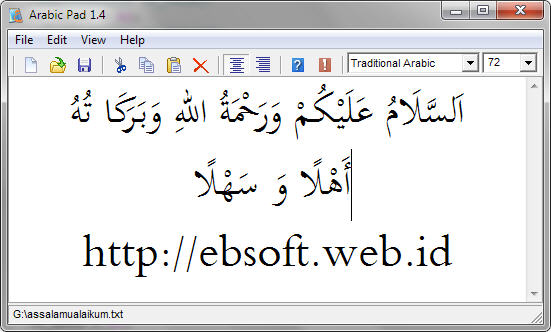
Writing Arabic with non Arabic windows or keyboard can be a frustrating jobs. But with Arabic Pad, this can be done easily.Arabic Pad is a simple editor like notepad, but designed to write Arabic [Unicode] text , especially for Non Windows Arabic. I hope that with this program write Arabic is more easily, by customizing the keyboard key so it’s close to the Arabic letter sound.
Setting your Computer (Windows 2000/XP)
Before you can using this program you must set your regional setting by add Supplemental language Support (right-to-left languages). If after run this program and the text doesn’t work correctly, the text were left aligned or the text were broken, then you must do the following step:
- Open Control Panel
- Select Regional and Language Options
- select Languages tab
- And check the options “Install files for complex script and right-to-left (Including Thai)” and click Apply.
- Insert the Windows CD Installer and locate the correct path requested.
- Follow the next step until the computer ask for restart, so restart.
If the above step still doesn’t work, maybe you have to install Universal Font. For Microsoft Office user, you can add Universal Font from the Installation CD. Follow this step :
- Open Control Panel
- Select Add or Remove Programs
- Select Microsoft Office and click Change
- Select Add of Remove Features click Next
- In the next step, check the “Choose Advanced Customization of Applications” and click Next
- From the tree view, Select: Office Shared Features > International Support > Universal Font (click/select and choose Run from my Computer from the drop down menu)
- Click Update
Character Map
| Main Arabic Letters | |||||||
| Arabic | Key | Arabic | Key | Arabic | Key | ||
|---|---|---|---|---|---|---|---|
| ا | a | ز | z | ق | q | ||
| ب | b | س | s | ك | k | ||
| ت | t | ش | S | ل | l | ||
| ث | Z | ص | c | م | m | ||
| ج | j | ض | C | ن | n | ||
| ح | h | ط | p | و | w | ||
| خ | K | ظ | P | ه | h | ||
| د | d | ع | ‘ | ء | x | ||
| ذ | D | غ | g | ى | Y | ||
| ر | r | ف | f | ي | y | ||
| Arabic | Key | Arabic | Key | Arabic | Key | ||
|---|---|---|---|---|---|---|---|
| أ | E | ؤ | W | ة | T | ||
| إ | I | ئ | O |
| Harokat | |||||||
| Arabic | Key | Arabic | Key | Arabic | Key | ||
|---|---|---|---|---|---|---|---|
| Fatha َ | e | Fathatan ً | ee | Sukun ْ | o | ||
| Kasra ِ | i | Kasratan ٍ | ii | ٓ | ~ | ||
| Dhomma ُ | u | Dhammatan ٌ | uu | Hamza above ٔ | < | ||
| Inverted Dhamma ٗ | U | Shadda ّ | v | Hamza below ٕ | > | ||
| Superscript Alif ٰ | A | Subscript Alif ٖ | II | ||||
| Additional for JAWI | |||||||
| Arabic | Key | Arabic | Key | Arabic | Key | ||
|---|---|---|---|---|---|---|---|
| چ | J | ڤ | F | ۏ | V | ||
| ڠ | G | ڬ | X | ڽ | N | ||
For other text such as number ( 0 ..9 ), comma (,), dot (.), semicolon (;), Question mark(?), Percent sign(%), five pointed star (*), and underscore ( _ ) just equal with normal alphabet.
License
Arabic Pad was release as freeware. This software is provided ‘as-is’, without any express or implied warranty. In no event will the authors be held liable for any damages arising from the use of this software. Permission is granted to anyone to use, copy, distribute this software in any form freely except for commercial purpose.
History
Version 1.4 Sunday, July 03 2011
- Some bugs when editing arabic and typing harakat were fixed
- Fixed for Fathatan, dhommatan and Kasratan
- Fixed double paste when using Ctrl+V
- Fixed for alif + mad harakat above
- Added new harakat : Inverted Dhamma, Subscript Alif
- New help file (Arabic Pad Guide), now using html format
Version 1.03 Monday, September 10 2007
- Add Arabic JAWI character ( used in Malaysia ) Cha, Nga, Pa, Gaf, Va and Nya ( req by Muhammad Zulkhibri Bin Musa)
Version 1.02 Tuesday, May 29 2007
- Add more character such as : comma, semicolon, question mark, percent sign, five pointed star, underscore ( to extend the character ), alif with hamza above or bellow, ya with hamza above, waw with hamza above.
Version 1.01 Monday, May 28 2007
- Fixed problem when load big files.
- Icon disappeared
Version 1.00 Friday, May 25 2007
- Initial Release
Download Arabic Pad
To download Arabic Pad ( 43 KB), select one of this download location :
- Arabic Pad 1.4 (box.net)
- Arabic Pad 1.4 (mediafire.com)
- Arabic Pad 1.4 (4shared.com)
- Arabic Pad 1.4 (jumbofiles.com)
software islamic Shollu 3.08.02
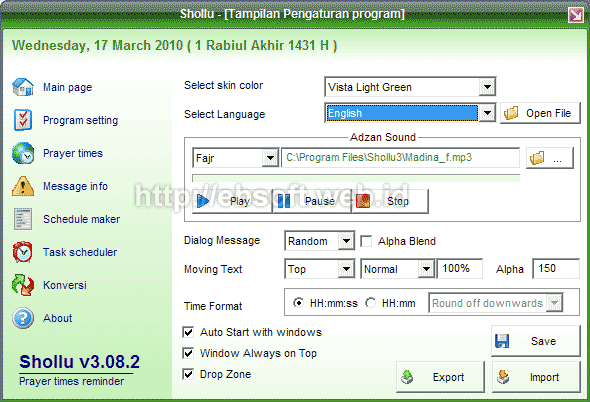
Shollu is an Islamic software that have main purpose to give warning, message or information to the user if prayer time is almost arrived in few minutes or is already arrived. So Moslem can prepare him self to get ready for pray. As Allah has already say in the Noble Quran, which meaning is:
“Verily, As-Salat ( the prayer) is enjoined on the believers on fixed hours” ( An-Nisa : 103)
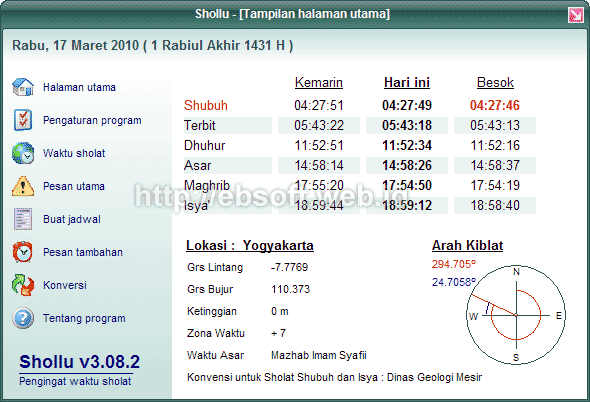
Different with version 2.15 and bellow that only support Indonesian cities, since version 3.00 Shollu, Islamic prayer times also support international place, because shollu v3.00 using Latitude, Longitude, Altitude, time zone and others parameter.
License
Shollu is a freeware ( you are free to use and distribute ). For details about license please look on the license.
Key Features
- Small executable size.
- Support for multi language, except for Unicode.
- Time format between HH:mm:ss or HH:mm
- New Skin, there are about 40 nice skin
- Support many cities in the world, included about 2.341 locations major cities in the world and also 400 Indonesian cities. If you need other locations you can download separated file that cover about 200 countries with more than 5 million places.
- Time calculation based on Latitude, Longitude, Altitude, Time zone and others.
- Automatic information message before, on and after prayer times.
- Message for Friday prayer
- Ability to show message from audio-video file for adzan ( mp3,wav,mid,midi,rmi or video like avi, mpg, asf etc, depend on your computer ).
- Task Scheduler which have features :
- Standard message with Information, Error, Warning and Question Icon.
- Run another program or application (type : command )
- Shutdown and Hibernate PC ( hibernate for win 2000/XP only)
- Frequently : daily, weekly, monthly, only once ( yearly ) and when the program start.
- Easy edit the task file ( task.dat )
- Show message with scrolling text
- Conversion date between Hijri (Islamic calendar) and Gregorian.
- Show information about prayer today times at specific duration time.
- Create a prayer times table :
- Time format between HH:mm:ss or HH:mm
- Select custom date
- Format HTML, csv and tsv
- Show Date in Hijri (Islamic calendar) and Gregorian
- Customize color.
Screenshot

Download Shollu
You can download Shollu (Islamic prayer times for moslem) from here:
- Shollu 3.08.2 ( on JumboFiles.com)
- Shollu 3.08.2 (from DropBox)
- Shollu 3.08.2 (on 4Shared.com)
- Shollu 3.08.2 (on SkyDrive)
- Shollu 3.08.2 (on CNET)
- Shollu 3.08.2 (on Softpedia.com)
MP3 QS MUHAMMAD WITH TRANSLATION INDONESIAN
 Surat Muhammad (Arabic: سورة محمد Muḥammad) is the 47th sura of the Qur'an with 38 ayat. The surah orders believers to obey Muhammad and not to reject any part of what he has revealed, as well as to "smite" and "subdue" the "unbelievers" in battle.[Qur'an 47:4]. This is often used against Muslims to describe their religion as violent, but it cannot be taken out of context[1][2][3]; the verse refers to the Battle of Badr, where the Meccans were gathering an army to attack Medina. This verse simply commanded the Muslims to defend themselves from this threat, and is not applicable in modern times[4]. However, although Islam maintains peace and orders its followers to treat all peoples with the due respect reserved for God's creations, this surah explicitly states in verse 7, "Oh you who believe! If you make God victorious, then He will make you victorious and make your foothold firm." The mandate is quite clear: the believer must strive to do good works in God's name alone for that is his/her purpose on this Earth, in turn God will provide everything for the believer to ensure that his/her good works continue. These "good works" must be actions that are commanded by God, namely being charitable and generous; seeking justice and equality; and being in a state of continual repentance and mindfulness of the Creator. These "good works" will not be accepted if they are innovations—basically actions otherwise not prescribed in the Qur'an and Sunnah.
 MP3 QS AL AHQAF WITH TRANSLATION INDONESIAN

Surat Al-Ahqaf (Arabic: سورة الأحقاف ) (The Wind-curved Sandhills, The Dunes) is the 46th sura of the Qur'an with 35 ayat. Prophet is ordained to relate to the people of Quraish not to worship other gods, but only Allah, the One and Only: (20) And remember (Hûd), brother of 'Ad, when he warned his people in Al-Ahqâf…: "Worship none but Allâh; truly, I fear for you the torment of a mighty Day” --- when they disobeyed and did not listen to the Messenger (brother of Ad) everything was destroyed. Allah says in (25) : “…Thus do We recompense the people who are Mujrimeen (guilty)!”
MP3 QS AL JATHIYA WITH TRANSLATION INDONESIAN

Surat Al-Jathiya (Arabic: سورة الجاثية) (Crouching) is the 45th sura of the Qur'an with 37 ayat.
MP3 QS AD DUKHAN WITH TRANSLATION INDONESIAN
 Surat Ad-Dukhan (Arabic: سورة الدخان ) (Smoke) is the 44th sura of the Qur'an with 59 ayat. SummaryThis Surat begins by glorifying Allah's power. It contains a prophetic description of a day, described as occurring before the Day of Judgment, in which the sky fills with a great smoke. The smoke is prophesied to cause enough chaos that people will cry out to Allah for reprieve. It also states that Allah destroys disbelieving nations, as he did to the ancient indonesians. Verses 43-46 describe Jahannam. In verses 51-57, Allah describes Jannah and promises Houris to men who lived in piety. إِسْتَبْرَقٍ Fallacy about its origin Depiction of the life of Paradise, in the Grand Qur’aan, is in such words and description that we can perceive it as if we are watching a video recording. Few scenes are of social gatherings and parties amongst family friends along with wives and youngster sons and grandsons. On such occasions, people tend to wear costly and beautiful dress. يَلْبَسُونَ مِن سُندُسٍ وَإِسْتَبْرَقٍ مُّتَقَابِلِينَ they people wear garments, green coloured made from natural yarn of fine silk, and lightening effect producing cloth [brocade], while they meet and confront each other [in celebrating parties]. [44:53] َإِسْتَبْرَقٍ This is one of few words of Grand Qur'aan which is considered by some as a borrowed word from Persian. This word refers to a peculiar cloth "Brocade" which was neither conceived nor produced by Persia. Its idea was conceived and cloth manufactured by the Chinese who exported and introduced it to Arabia. Therefore, the presumption of its being a borrowed word from Persia seems ridiculous, on face value. Language is a medium to transmit and convey knowledge and perceptions from one mind to another mind. This transfer and transportation can be possible and could be termed as the best only if the listener and reader could infer and perceive exactly what was in the mind and heart of the first person. The language comprises of words. Therefore, for the exact transfer of knowledge and perception from one mind to another mind the words must have distinct and predefined meanings conveying a specific perception. The words must make two things distinct from each other to earn eloquence to the language. A noun, in any language, refers and indicates a thing, object, state etc. It gives us a perception about the apparent physical features and dimensions of the object whereby we may also perceive some other information known and related to it. A word in fact verbally mirrors the static image of physical realities relating to that object or phenomenon. We can also say that a word is in fact the transformation of a physical reality to sound articulated in a peculiar way. However, majority of the nouns of non-Arabic languages do not depict and convey abstract or hidden realities inherent in those objects and at times even may lack to mirror physical fact satisfactorily. However, in Arabic, all words emanate from a Root-source, which is, but three or four consonants of the language arranged in a peculiar sequence. Each Root of Arabic is unique and distinct and enfolds in it a peculiar and distinct perception and meanings. The most strange and highly scientific aspect of the Roots of Arabic language is that they enfold all physical/scientific realities and facts relating to both matter and life. The words will always contain and reflect the basic perception of its mother i.e. Root wherever and in whatever context they find mention The idea/thought or "verbal specification" of anything precedes the physical emergence and actualization of that thing. The created object in fact physically mirrors that thought-conception. The word assigned to describe the object is eloquent and succinct only if it portrays the thought-conception, which caused that object to take existence. The Arabic noun إِسْتَبْرَقٌ names and leads towards a fabric, which is obviously a physical object and NOT an abstract thought or concept. It refers to fabric, which finds named in English as "Brocade". It denotes, "a heavy fabric with a raised design and as a transitive verb denotes weave a fabric with raised design". [Dictionary, Encyclopedia Encarta]. The online Wikipedia says; "The name, related to the same root as the word "broccoli", comes from Italian broccato meaning "embossed cloth," originally past participle of the verb broccare "to stud, set with nails," from brocco, "small nail," from Latin broccus, "projecting, pointed." The best course to arrive at the true origin of the word is to trace back the origin of the object it refers. It takes us 1500 years back in time to Jiankang, present-day Nanjing City of China. There we are introduced "Nanjing Yunjin" the incredibly beautiful brocade made in Nanjing, capital city of eastern Jiangsu Province. Yun in Chinese means "clouds", and jin means "brocade". The Grand Qur'aan, more than 1400 years back, described this fabric as إِسْتَبْرَقٌ . It is derived from Root "ب ر ق". There is also a perfect verb from this Root similarly spelled إِسْتَبْرَقٌ Form-X. Measure X generally means to seek out or aspire for the meaning of Measure I onto ones self. The Arabic word إِسْتَبْرَقٌ conveys a perception in relation to the fabric as that which has acquired for itself the trait and resemblance of بَرْقٌ i.e. natural lightening. The wearing of dress made of such fabric finds mention in the social gatherings/celebrative parties held amongst friends in the Paradise. In times of revelation of Grand Qur'aan this fabric dress was indication of status, associated with luxury and opulence, and garments kept especially for ceremonial events. Now keeping in mind the Arabic Root and the word with its connotations let us see what the "Yunjin-Cloud Brocade" is. It was used exclusively by the imperial houses or as gifts bestowed by the emperors on princes or senior officials in ancient China. Yun Brocade of Nanjing is praised as "One of Unique Chinese Techniques", and "Treasure of the World". It is obvious that because of high-quality silk and an object of use by imperial houses and princesses, it was light and soft. A 1.28-meter-long silk coat with a pair of long sleeves is one of the relics discovered in the Mawangdui Han Tomb, in China. It is as light as the mist and as fine as gossamer, weighing a mere 49 grams. An inch of Cloud brocade was said to be as valuable as an ounce of gold by the ancient Chinese. What is interesting is that the delicate and soft brocade came out from wooden looms as big as 5.6-meters long, 4-meters high and 1.4-meters wide. The weaving technology of the brocade is exceedingly complex and exquisite, and no modern machine has yet been able to replace the ancient looms. The huge looms needed two operators, one above and one below in the delicate production sequence that was as complicated as a current computer programming language. The person sitting at the loom was known as a "thread puller". The person sitting on the lower part of the loom was called a "weaver". A woven fabric self-patterned. It is a silk weave and the pattern has a reversible positive/negative image. It relies on the play of light to give dimension to the pattern, which is subtle and rich at the same time. One side of the cloth always has darker face over the other. The pattern is created when light falls on the fabric. The light reflects off areas of visible arranged fabric warp threads, which look shiny against visible weft threads that look dull within the weave. This fabric satisfies the requirement that imperial articles should be graceful, resplendent and magnificent. Another acquired feature of "Brocade" is its being resplendent which it exactly shares with بَرْقٌ i.e. natural lightening. The effect of lightening is dazzling, immediately after flash there is a dark shade for the sight. Brocade has this peculiar feature, created with great skill by some brainy Chinese producing exactly what is the effect of lightening. The Arabic word mirroring this cloth seems to have made a correction to the "Yunjin"-Cloud Brocade, since its features and peculiarity is not relevant to all the clouds. Not all clouds produce Lightening. Cumulonimbus or thundercloud, الْمُعْصِرَاتِ in Arabic, they produce lightening بَرْقٌ. Can there be a word better than إِسْتَبْرَقٌ in any other language that could portray the idea and conception that was in the mind of that Chinese who conceived and produced this fabric? May be, tomorrow, the scientists find a similarity between the "mystic" process of its weaving with interaction of the upper positively charged part with the lower negatively charged part of the thundercloud. During its weaving the thread puller sits on top of the loom and lifts the warp while the weaver, sitting under it, weaves the weft with gold and colored threads.
 MP3 QS AZ ZUKHRUF WITH TRANSLATION INDONESIAN

Surat Az-Zukhruf (Arabic: سورة الزخرف) (Ornaments Of Gold, Luxury) is the 43rd sura, or chapter, of the Qur'an, the central religious text of Islam. It contains 89 ayat, or verses.
MP3 QS ASH SHURA' WITH TRANSLATION INDONESIAN
 Surat Ash-Shura (Arabic: سورة الشورى) (Council, Consultation) is the 42nd sura of the Qur'an with 53 ayat.
MP3 QS AL FUSHILAT WITH TRANSLATION INDONESIAN
 Surat Fussilat (Arabic: سورة فصلت) (Explained In Detail), also known as Surat Ha Mim al-Sajda (Arabic: سورة ﺣﻢ ﺍﻟﺴﺠﺪﺓ) is the 41st sura of the Qur'an with 54 ayat. سَنُرِيهِمْ آَيَاتِنَا فِي الآَفَاقِ وَفِي أَنْفُسِهِمْ حَتَّى يَتَبَيَّنَ لَهُمْ أَنَّهُ الْحَقُّ أَوَلَمْ يَكْفِ بِرَبِّكَ أَنَّهُ عَلَى كُلِّ شَيْءٍ شَهِيدٌ We will henceforth keep visually exposing, Our tangible-physical realities prevalent in the Universe and in their own bodies, to the eyes of those who do not accept the Qur'aan, in order that it may become evident/manifest for them that this Qur'aan is a statement of proven fact.[reverting to their conduct] Do you think that your Sustainer Lord has not yet been considered ultimate observer? The fact is that He is watcher/omnipresent upon each and every thing? [41:53] The Grand Quran has informed that Allah will keep bringing to human visual observation, the knowledge about the universe and human body, and it will become manifest to the people that the Qur'aan is a statement of proven fact/absolute reality. Why a first time visual observation of hitherto unseen thing manifests that, the Qur'aan is a statement of proven fact? This is possible only if the same thing verbally finds mention of it in the Qur’aan. Verbal specification and visual observation are in fact two aspects/methods of identification of a tangible fact of real existence, as denoted by Arabic word ءَايَةٌ. The visual observation of an earlier unseen fact by humans will manifest that Book as a Book of fact which, written earlier in time, contains its verbal presentation. This will establish that the Book really contains verbal statements of physical/scientific facts and is not conjectural, hypothetical and presumptive in its contents. Wisdom is that state of acquisition of knowledge when the invisible of the matter/relationship {باطن} becomes visible/ perceivable through vision and intellect. However, the remote past and remote future is beyond our vision and perception. Notwithstanding what distance we could cover in the past and the future we can never say with confidence/certainty that we have reached and seen/perceived the things at the point of beginning or ending in future. We can never encompass the matter in its entirety not only because of its extremely voluminous and diversified nature but also because we know the skies are expanding all the time, therefore if we can manage to reach its today's last boundary/limit it would have gone farther the moment we reach the point we thought is the ending point. It is an endless pursuit; this is the limitation of our capability of vision and intellect. We will always end up in a closed street. Knowledge is primarily divided into two branches; knowledge of things/matter and what happened/was talked about by the people/their dialogues/habits/acts in the past. The knowledge about the matter is verifiable in time and space. Anything said by anyone/book regarding physical matters could be subjected to verification in time and space about its truth to an exact detail. If we find the words of a book relating to physical matters written earlier in time as true and factually and materially correct in all respects then we will have to believe too, in those statements of the Book which narrate some events/dialogues between people of past/historical statements. The falsification test of any book/statement could be the physical one. The facts mentioned in the Qur'aan about the Universe and human body is in itself also the falsification test of the Book.
 MP3 QS AL GHAFIR WITH TRANSLATION INDONESIAN
 Surat Ghafir (Arabic: سورة غافر) (The Forgiver (Allah)), also known as Surat al-Mu'min (Arabic: سورة المؤمن) is the 40th sura of the Qur'an with 85 ayat.
 MP3 QS AZ ZUMAR WITH TRANSLATION INDONESIAN

Surat Az-Zumar (Arabic: سورة الزمر) (The Troops, Throngs) is the 39th sura of the Qur'an with 75 ayat.
MP3 QS SHAD WITH TRANSLATION INDONESIAN

Surat Sad (Arabic: سورة ص) (The Letter Sad) is the 38th sura of the Qur'an with 88 ayat. ص~ وَالْقُرْآنِ ذِي الذِّكْرِ 38:01 Sād [Fifteenth-centre/middle letter of the 29 letters of Arabic Alphabet, with ancillary glyph/prolongation sign/mark which extends/stretches the sound value of the letter to which it is added. Prolongation sign/mark is found whenever the following word begins with still letter and here Sād ending with sound of still "Daal" in pronunciation. As a numeral, it denotes 90-reflecting the entire range from 0 to 9. Interestingly its head part is used in Grand Qur'aan as a sign to suggest linkage in recitation]; and swearing is by the Qur'aan, its peculiarity is that it is the holder/container of the Admonishment/Reminder/Reiteration [of all that was sent earlier-a linkage]. [38:01] بَلِ الَّذِينَ كَفَرُوا فِي عِزَّةٍ وَشِقَاقٍ 38:02 Nay, their utterances are false, the fact of the matter is that those who have deliberately refused to accept [Grand Qur'aan] they are in the perception of holding power/control/status quo and in retaining/maintaining a separate identity/entity [as against the Qur'aan that intends to link the humanity as a homogenous unit]. [38:02] [Read in conjunction 2:137,176;22:53;41:52] o كِتَابٌ أَنزَلْنَاهُ إِلَيْكَ مُبَارَكٌ لِّيَدَّبَّرُوا آيَاتِهِ وَلِيَتَذَكَّرَ أُوْلُوا الْأَلْبَابِ 38:29 The Book, We have sent it to you, the Messenger [Sal'lallaa'hoalaih'wa'salam]. This has the peculiar characteristic of permanence and perpetuation-to stay forever. The purpose and objective is that the people may pursue/critically examine/link/study its Aa'ya'at-verbal passages mirroring established realities and facts; and so that the men of wisdom who look into matters and conduct objectively without overlapping it with emotions/prejudices/biases/whims/caprices may remember and orate to others. [38:29] قَالَ رَبِّ اغْفِرْ لِي وَهَبْ لِي مُلْكًا لَّا يَنبَغِي لِأَحَدٍ مِّنْ بَعْدِي إِنَّكَ أَنتَ الْوَهَّابُ 38:35 Sulie'maan [alai'his'slaam] prayed, "O my Sustainer Lord, forgive for me; and You grant me such a rule of kingdom that it may not be possible for a single one after me to acquire it for himself; indeed You are The Benefactor/The One Who bestows" [38:35] فَسَخَّرْنَا لَهُ الرِّيحَ تَجْرِي بِأَمْرِهِ رُخَاءً حَيْثُ أَصَابَ 38:36 [Accepting his prayer] In response We subjected for him the particular breeze [grain producer 21:81]. It moved/blew under his command [towards their land-21:81] gently from the direction/place wherever he had found it. [38:36]
MP3 QS ASH SHAFAT WITH TRANSLATION INDONESIAN
 Surat As-Saaffat (Arabic: سورة الصافات) (Those Who Set The Ranks, Drawn Up In Ranks) is the 37th sura of the Qur'an with 182 ayat.
 MP3 QS YASIN WITH TRANSLATION INDONESIAN

Yā Sīn (Arabic: سورة يس literally "O Sin is the 36th 'chapter' of the Qur'an with 83 ayah, and is one of the Meccan sura. It is given the title of "the Heart of the Qur'an" Opening with the Arabic letters "Yāʾ" and "Sīn", possibly referring to the Islamic prophet, Muhammad, since Ya also means "O" while "Sin" is often interpreted as indicating insan (human). The context seems to indicate this interpretation as well, as verses 3-6 specifically address the Prophet. Yasin is used as a name in the Islamic world. This chapter of the Qur'an covers many of the themes of the Qur'an, but primarily focused on arguments for belief in God.[3] The arguments arise in three forms: a historical parable, a reflection on the order in the universe, and lastly a discussion of resurrection and human accountabilit
MP3 QS FATIR WITH TRANSLATION INDONESIAN
 Surat Al-Mala'ikah "The Angels", also known as Fatir ( سورة فاطر sūratu fāṭir) "Originator" is the 35th Sura of the Qur'an with 45 ayat.
 MP3 QS SABA' WITH TRANSLATION INDONESIAN
 DOWNLOAD NOW
MP3 QS AL AHZAB WITH TRANSLATION INDONESIAN

Surat Al-Ahzab (Arabic: سورة الأحزاب ) (The Clans, The Coalition, The Combined Forces) is the 33rd sura of the Qur'an with 73 ayat. Verse 5: Adoption in Islam. Ayat 6 contains a reference to the term Mother of Believers. Ayat 25 contains a reference to Battle of the trench. Ayat 26 contains a reference to the Siege of the Banu Qurayza. Ayat 28-34 contains a reference to Muhammad's wives. Ayat 33 contains a reference to Ahl al-Bayt(the Event of the Cloak) and its name is Verse of purification. Ayat 40 contains a reference to Finality of Prophethood. See last prophet. Ayat 50 was revealed pertaining to Maymuna bint al-Harith. Ayat 59 uses the word jalabib, the plural of jilbāb. This verse is used as evidence that jilbāb is incumbent upon Muslim women. Ayat 72 is called "The Verse of the Trust"
MP3 QS AS SAJDA WITH TRANSLATION INDONESIAN
According to Tafsir ibn Kathir, Imam Ahmad recorded that Jabir said, "The Prophet would never sleep until he recited: Alif Laam Meem, the revelation of....(Surah Sajda) and Blessed be He in Whose Hand is the dominion...
MP3 QS AL LUQMAN WITH TRANSLATION INDONESIAN
Luqman was described as a perceptive man, always watching the animals and plants of his surroundings, and he tried to understand the world based on what he saw. One day, whilst sleeping under a tree, an angel came to him and said Allah wanted to bestow a gift upon Luqman: either wisdom or prophecy. Luqman chose wisdom, and when he woke from his slumber, he was aware that his senses and understanding had sharpened. He felt in complete harmony with nature and could understand the inner meaning of things, beyond their physical reality. Immediately he bowed down, thanked and praised Allah for this wonderful gift. Unfortunately, Luqman was captured by slavers and sold as a slave
Luqman was deprived of his freedom. He could neither move nor speak freely. This was the first trial he had to bear. He suffered his bondage patiently, for his heart was lit with faith and hope, and he was waiting for Allah's action.
The man who bought him was a good as well as an intelligent man. He treated Luqman with kindness. He was able to detect that Luqman was not an ordinary man and tried to test his intelligence. He ordered Luqman to slaughter a sheep and to bring its worst part to him. Luqman slaughtered the sheep and took its heart and tongue to his master. On receiving them his master smiled, fascinated by Luqman's choice of the 'worst'. He understood that Luqman was trying to convey some deep meaning, though he could not make out exactly what. From this moment his owner began to take more interest in Luqman and showed more kindness to him.
A few days later, Luqman was again instructed to slaughter a sheep, but this time he was asked to take the best parts of the animal to the owner. Luqman slaughtered a sheep, and to his master's amazement, again brought the same organs (the heart and the tongue). His master asked Luqman how the heart and the tongue could be both the worst and the best parts. The wise Luqman answered: The tongue and the heart are the sweetest parts if its owner is pure; and if he is wicked, they too are as wicked ! Thereafter, Luqman's owner held him in great respect. Luqman was consulted by many people for advice, and the fame of his wisdom spread all over the country.
Surat Luqman, a Meccan surah, is the 31st surah (chapter) of the Qur'an with 34 ayat (verses). This surah reminds the believer that God ensures His Protection to those who remain steadfast in the salat (prayers) and give their wealth to those who are needy, granted that the intentions are pure. This sura addresses the issue of the respect due to one's parents when it comes to the worship of God. "And We have enjoined on man (to be good) to his parents: in travail upon travail did his mother bear him, and in years twain was his weaning: (hear the command), "Show gratitude to Me and to thy parents: to Me is (thy final) Goal." (Ayah 14) God acknowledges the authority parents have over their children--the mother for bearing the child throughout the hardship of pregnancy and labor. But when the parents are leading their children astray from the true worship of God, God says, "But if they strive to make thee join in worship with Me things of which thou hast no knowledge, obey them not; yet bear them company in this life with justice (and consideration), and follow the way of those who turn to me (in love): in the end the return of you all is to Me, and I will tell you the truth (and meaning) of all that ye did." (Ayah 15) But God reminds the believer, "Verily the knowledge of the Hour is with Allah (alone). It is He Who sends down rain, and He Who knows what is in the wombs. Nor does any one know what it is that he will earn on the morrow: Nor does any one know in what land he is to die. Verily with Allah is full knowledge and He is acquainted (with all things)." (Ayah 34)
The Hadith teaches us that for some bondsmen, a high rank has been determined. But sometimes, that bondsman has not acquired the good deeds to reach to such a high rank. Hence Allah causes him to become involved with some calamity, which if he accepts and bears patiently, he is able to reach that high position. According to the Hadith, when Luqman was teaching, he was asked, "What has brought you to be like this?" meaning his high rank. Luqman said, "Truthful speech, fulfilling the trust, and leaving what does not concern me."[2]
Luqman gave his son the following advice which is recorded in the Qur'an:
"13 Behold, Luqman said to his son by way of instruction: "O my son! join not in worship (others) with Allah. for false worship is indeed the highest wrong-doing." 14 And We have enjoined on man (to be good) to his parents: in travail upon travail did his mother bear him, and in years twain was his weaning: (hear the command), "Show gratitude to Me and to thy parents: to Me is (thy final) Goal. 15 "But if they strive to make thee join in worship with Me things of which thou hast no knowledge, obey them not; yet bear them company in this life with justice (and consideration), and follow the way of those who turn to me (in love): in the end the return of you all is to Me, and I will tell you the truth (and meaning) of all that ye did." 16 "O my son!" (said Luqman), "If there be (but) the weight of a mustard-seed and it were (hidden) in a rock, or (anywhere) in the heavens or on earth, Allah will bring it forth: for Allah understands the finest mysteries, (and) is well-acquainted (with them). 17"O my son! establish regular prayer, enjoin what is just, and forbid what is wrong: and bear with patient constancy whatever betide thee; for this is firmness (of purpose) in (the conduct of) affairs. 18 "And swell not thy cheek (for pride) at men, nor walk in insolence through the earth; for Allah loveth not any arrogant boaster. 19"And be moderate in thy pace, and lower thy voice; for the harshest of sounds without doubt is the braying of the ass."" (Quran, 31:13-19)
Subscribe to:
Posts (Atom)